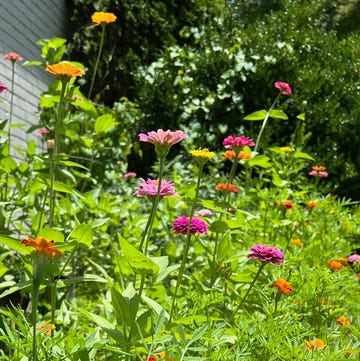
30 Best Orange Flowers for Your Garden to Add Dimension and Color
With different shapes, sizes and hues, these blooms will have you loving their bright hues.

Looking to widen the color palette in your garden? If you haven't planted any orange flowers, they're worth adding. Orange flowers add vibrancy and a pop of color that draws the eye.
You won't lack for choices, either. There are a wide array of orange flowers to choose from. Whether you're adding flowers to a container garden on your porch or patio, to a pollinator garden in raised beds, or to your cottage garden or wildflower garden, there are orange blooms that will fit right in.
Choosing native varieties and flowers that pollinators love is an easy way to attract beneficial insects to your front or back yard or balcony. This is also an easy way to create biodiversity in your space and repel unwanted bugs without pesticides. Some orange flowers have a tubular shape that draws in hummingbirds, while others have plenty of nectar for bees and butterflies.
You can grow orange flowers in all shapes, sizes and heights to attract different pollinators while creating texture and dimension to your landscape. For bright and colorful blossoms all year long, select flowers with blooming times throughout the year. Spring and summer offer the widest variety of blooms, but there are orange flowers that bloom in the fall and winter, too.
Plus, these flowers will add color and a bright spark to your space when there's less growing as well as fewer food sources for pollinators.
Looking for other colors of flowers to plant?
Black-eyed Susan (Rudbeckia hirta)

Looking for more flowers that attract important pollinators? Grow Rudbeckia, a native wildflower that attracts bees, butterflies and other beneficial insects. You can expect flowers from June through August.
Type: Biennial, USDA Hardiness Zones 3 to 9
Light: Full sun
Chrysanthemum (Chrysanthemum X morifolium)

Blooming in late summer until the beginning of fall, these multi-petaled flowers make a statement. Plant in a sunny area where they'll receive ample sun.
Type: Annuals and perennials, USDA Hardiness Zones 4 to 9
Light: Full sun
Bird of paradise (Strelitzia reginae)

Birds of paradise are tropical plants native to Southern Africa that produce stunning flowers. They can be grown as a houseplant, though they are less likely to produce flowers.
When growing outdoors, plant them in full to partial sun, though they need a respite from the intense heat of the midday sun.
Type: Perennial, USDA Hardiness Zones 10 to 12
Light: Full to partial sun
Read more: How to Grow Birds of Paradise
Bearded Iris (Iris germanica)

The bearded iris makes a statement in the garden with its big blooms. Consider growing the variety Chariot of Fire. Grow in full sun and well-drained soil.
Type: Perennial, USDA Hardiness Zones 3 to 9
Light: Full sun
Read more: How to Care for Irises
Butterfly weed (Asclepias tuberosa)

Butterfly weed (Asclepias tuberosa) is an important food source for butterflies. If you live in the eastern or southern United States, consider growing this plant as it's native to the area.
Type: Perennial, USDA Hardiness Zones 3 to 9
Light: Full sun
California poppy (Eschscholzia californica)

The state flower of California, hence the name, these flowers are native to the western United States. The delicate blooms will brighten any garden and appear at the end of spring to early summer.
Type: Annual
Light: Full sun
Daisy (Bellis perennis)

Want an easy flower to grow from seed? Plant some daisies in full sun. With many varieties to choose from, consider ones with distinct bloom times so you have flowers in the garden throughout the seasons.
Type:
Perennial, USDA Hardiness Zones 4 to
Light: Full sun
More: 25 Colorful Types Of Daisies That'll Brighten Your Garden
Day lily (Hemerocallis fulva )

Daylilies are easy to grow and can handle some neglect. Despite the name, they aren't a true lily.
Type:
Perennial, USDA Hardiness Zones 4 to 9
Light: Full sun to partial shade
Red Hot Poker (Kniphofia)

Want to add flare and texture to the garden? Grow Red Hot Poker. They have torch-shaped flowers that pollinators love, including bees, butterflies and hummingbirds.
Type: Perennial, USDA Hardiness Zones 5 to 9
Light: Full sun
Related: How to Plant a Pollinator Garden That Actually Works
Calendula (Calendula officinalis)

Calendula, or pot marigolds are fun annuals to grow and you can start them easily from seed or buy them at your local nursery. Fun fact: Planting them in your vegetable garden can help keep aphids off your broccoli! (Here are 10 More Plant Combos You Should Grow Side-by-Side.)
Type: Annual
Light: Full sun to partial shade
Canna lily (Canna spp.)

Canna lily is not part of the genus Lilium, also known as a true lily. They're more closely related to ginger and bananas. Plant in full sun to ensure they flourish.
Type: Perennial, USDA Hardiness Zones 8 to 11
Light: Full sun
Giant Montbretia (Crocosmia Masoniorum)

Giant Montbretia produces beautiful funnel-shaped flowers in late summer. These make a wonderful garden plant to admire year-round.
Type: Annual or Perennial, USDA Hardiness Zones 6 to 9
Light: Full sun
Dahlia (Dahlia spp.)

With globe-like blooms, dahlias are cool to grow in the garden. Want blooms throughout the summer and many different colors, like yellow, purple, red, pink and white? Give 'em lots of sun and well-draining soil.
Type: Perennial, USDA Hardiness Zones 8 to 11
Light: Full sun
Learn More: How to Care for Dahlias and Make a Statement in Your Garden
French Marigold (Tagetes patula)

French marigolds are often smaller and more compact than the classic marigold. These can grow as tall as 2 feet tall.
Type: Annual
Light: Full to partial sun
Orange lily (Lilium bulbiferum)

Blooming at the beginning of the summer, the orange lily is a vibrant flower with six petals. Each bulb typically produces six flowers.
Type:
Perennial, USDA Hardiness Zones 3 to 9
Light: Full sun to partial shade
Rose

If you love to stop and smell the roses, you likely have a couple of rose bushes growing in your yard. Roses are versatile and you can choose the classic style rose or a climbing variety.
Type:
Perennial, USDA Hardiness Zones 6 to 8
Light: Full sun
Honeysuckle (Lonicera spp.)

Honeysuckles are vining plants that need support, such as a trellis, post, fence or arbor to climb. Most attract pollinators and hummingbirds. Before you purchase, make sure to choose a non-invasive variety for your region.
Type: Perennial, USDA Hardiness Zones 5 to 9
Light: Full sun
Hardy Hibiscus (Hibiscus spp.)

Hardy hibiscus flowers can add a tropical flare to your garden with their voluptuous blooms in an array of colors.
Type: Perennial, USDA Hardiness Zone 4 to 9
Light: Full sun to partial shade
Lantana (Lantana camara)

Lantana (Lantana camara) have pom-pom shaped blooms, made up of numerous smaller flowers. These cool plants bloom in the summer and part of the fall.
Type: Perennial, USDA Hardiness Zone 7 to 11
Light: Full sun
Marigolds (Tagetes spp.)

Marigolds are annual flowers that attract pollinators to the garden. These multi-petaled flowers are common as companion plants, often planted with tomatoes to repel pests, such as whiteflies. Some varieties deter root-knot-nematodes. They also are used as border plants to reduce rabbits from eating your flower buffet.
Type: Annual
Light: Full sun


The 8 Summer Gardening Tasks Experts Never Skip

The Tastiest Fall Fruits and Veggies in Season Now

Cold-Loving Winter Flowers to Brighten Dark Days

How to Seed Your Lawn Like a Pro This Fall